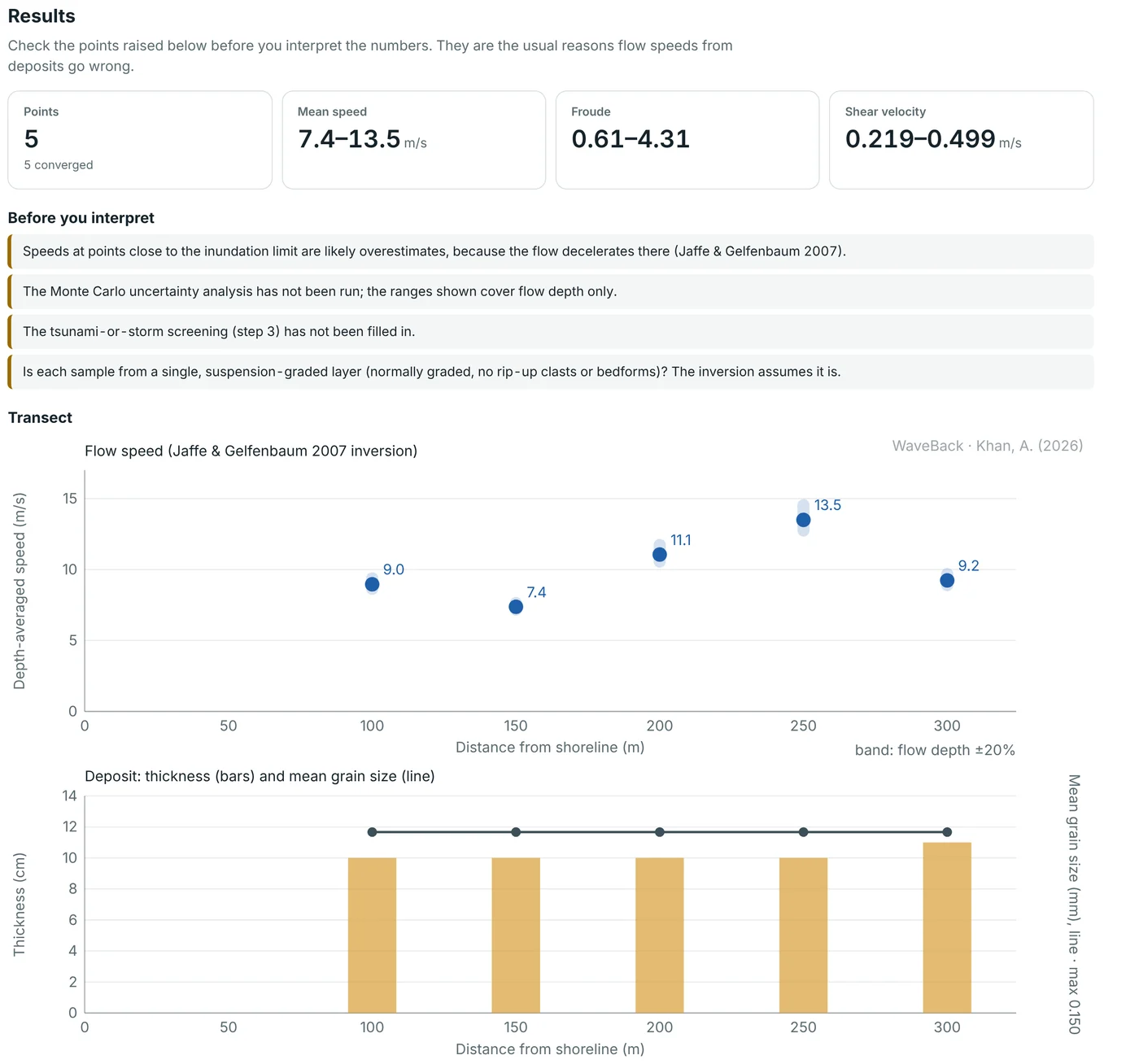
WaveBack estimates the flow speed, depth and run-up of a tsunami from the thickness and grain size of the deposit it left. It runs established inverse and run-up models, checks the results before you interpret them, and writes the methods and results paragraphs. No coding, and it runs offline in your browser.

Seven steps: Project, Deposits, Origin, Flow speed, Run-up and checks, Results and Export. The published benchmark of Jaffe and Gelfenbaum (2007) is built in as a demo.
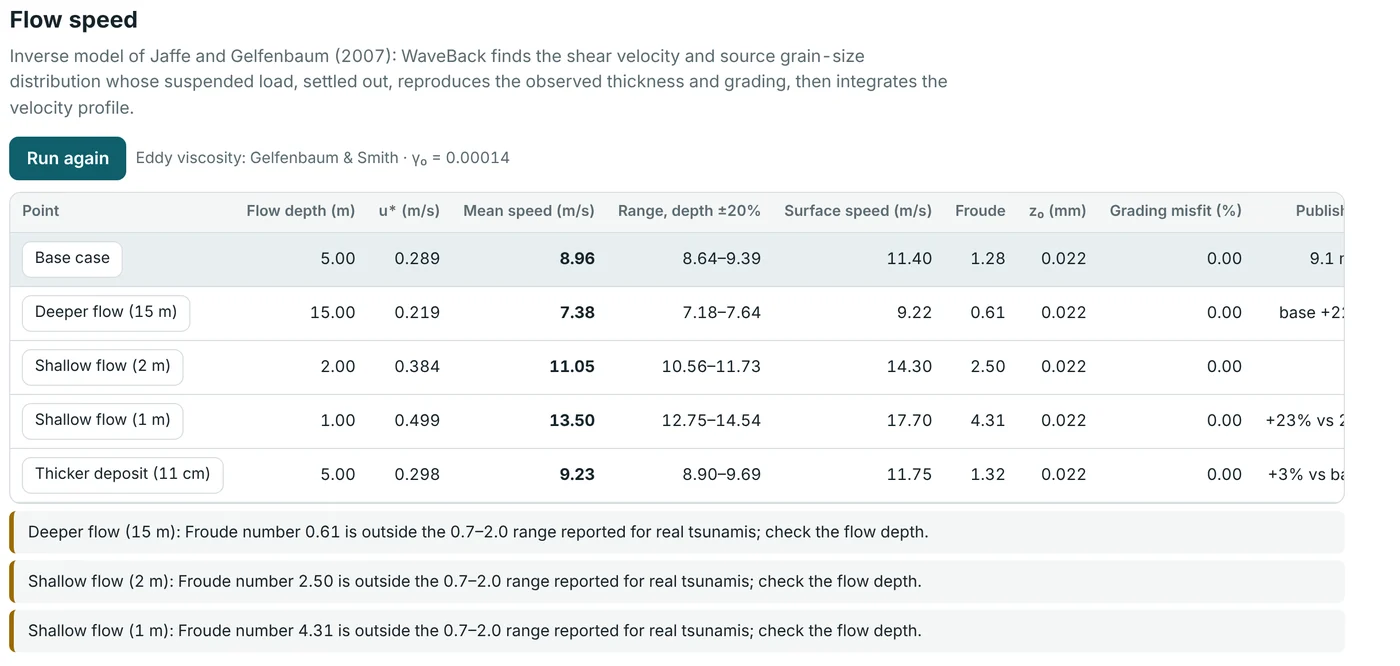
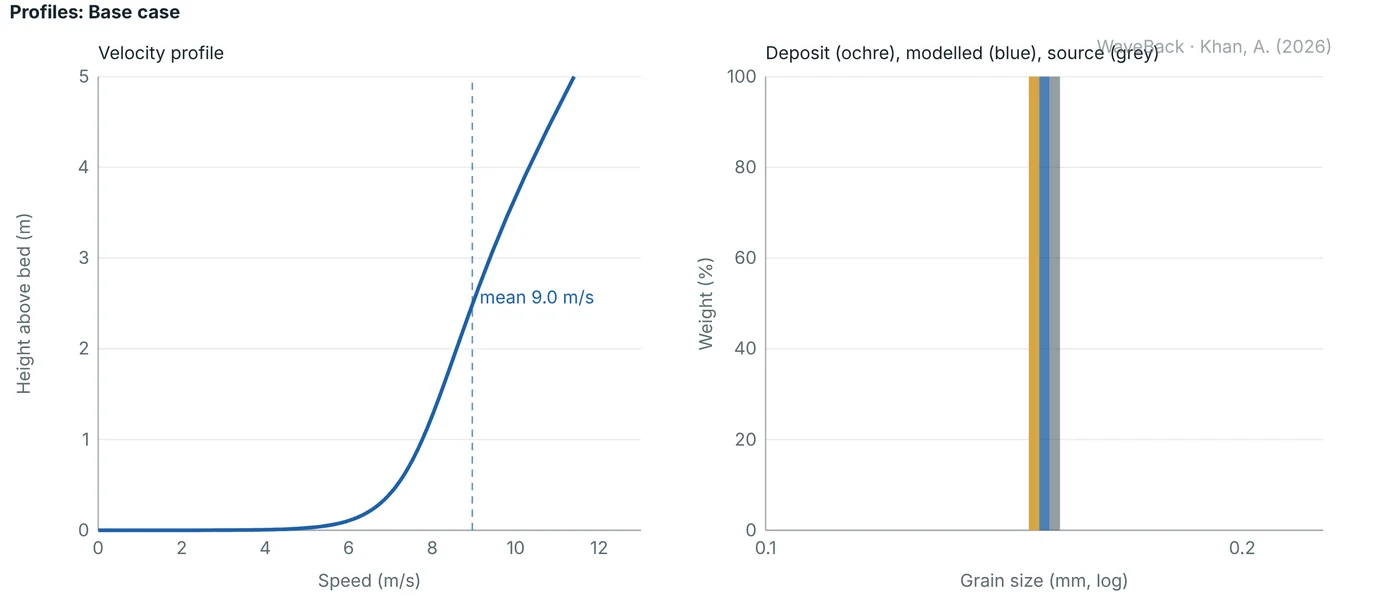
WaveBack uses the inverse model of Jaffe and Gelfenbaum (2007): it finds the shear velocity and source grain-size distribution whose suspended load, settled out, reproduces the observed thickness and grading, then integrates the velocity profile.

For every sampling point you see the velocity profile through the flow and how the modelled deposit compares with the observed one, so you can judge each inversion rather than trust a single number.

The advection model of Moore et al. (2007) gives a minimum speed, and the sediment run-up model of Soulsby et al. (2007) places the water's landward limit. For older deposits, a compaction correction and a mud cut-off keep the inversion realistic. Before you interpret, WaveBack lists the conditions that most often make flow speeds wrong.

Pro adds the evidence and uncertainty that reviewers ask for.
29 sedimentary, microfossil, heavy-mineral, lake, boulder-field and offshore criteria and 10 wave and flow characteristics, each with its published tsunami and storm ranges and its source. Your data suggest answers that count only after you confirm them. The result is a leaning, never a verdict.
Hundreds of reruns per point, varying thickness, flow depth, grain size, the resuspension coefficient and bed concentration together: median speed and Froude number with 95% ranges, histograms and a reproducible seed.
Flow depth at each point from a surveyed ground profile and a level or sloping water surface, so depth no longer has to come from an assumed Froude number; run-up height at the inundation limit.
Minimum flow speed to slide, overturn or lift a boulder after Nandasena et al. (2011), with the full-weight option of Bressan et al. (2018), without converting it into wave heights.
| Feature | Free | Pro |
|---|---|---|
| Flow speed inversion (Jaffe and Gelfenbaum 2007), three eddy-viscosity profiles | ✓ | ✓ |
| Flow depth from a Froude number or a depth range | ✓ | ✓ |
| Moore et al. (2007) advection and Soulsby et al. (2007) run-up | ✓ | ✓ |
| Compaction correction and mud cut-off for paleotsunami deposits | ✓ | ✓ |
| Checks before interpretation; methods and results paragraphs | ✓ | ✓ |
| CSV, SVG and PNG exports; project files | ✓ | ✓ |
| Tsunami or storm screening: 29 criteria and 10 wave and flow characteristics | – | ✓ |
| Boulder transport (Nandasena et al. 2011) | – | ✓ |
| Monte Carlo uncertainty with 95% ranges and histograms | – | ✓ |
| Ground profile and water surface; run-up height | – | ✓ |
No subscription. Buy once and keep it.
Free for research and teaching (CC BY-ND 4.0)
Also archived on Zenodo.
Single-user licence, use on all your own computers
🔒 Secure checkout by Paddle · 30-day money-back guarantee
Online checkout is opening shortly. To buy now, email [email protected].
Prices in US dollars; local taxes are added at checkout where applicable. Lab, department and teaching licences: contact us.
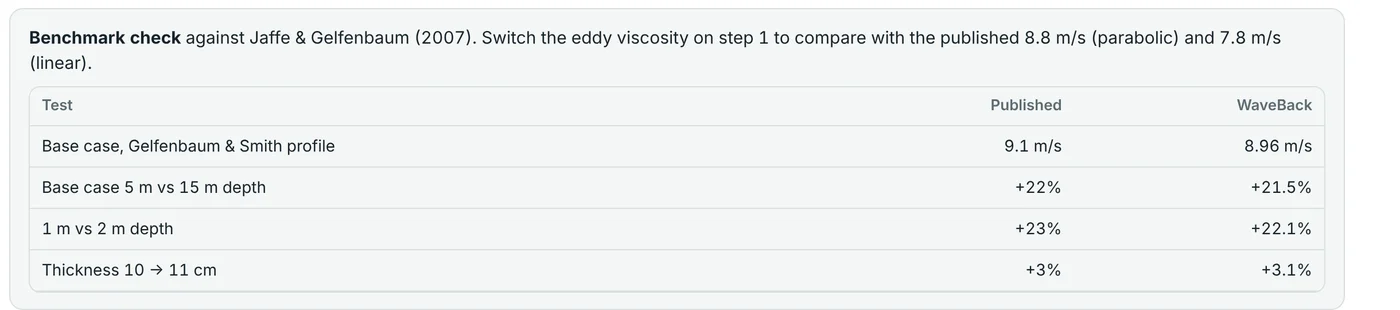
WaveBack reproduces the published benchmark and matches an independent implementation of the same equations.
Benchmark speed against the published 9.1 m/s of Jaffe and Gelfenbaum (2007), Gelfenbaum and Smith profile; 8.62 vs 8.8 (parabolic) and 7.67 vs 7.8 m/s (linear).
Sensitivity tests to flow depth, thickness and the resuspension coefficient agree with the published percentages.
Independent check: the largest relative difference from an independent Python implementation, Monte Carlo samples included.
Monte Carlo on the benchmark: every run converged; the same seed repeats the same medians and ranges.
Ground profile and boulder modules reproduce hand calculations for level and sloping water surfaces and for sliding, overturning and lifting.
Independent review before launch: every issue a separate tester found was fixed and re-tested in version 1.3.1.
A recent desktop browser: Chrome, Edge or Firefox. There is nothing to install and no internet connection is needed, and no data leaves your computer.
For each sampling point: distance from the shoreline, deposit thickness, flow depth if known, and the grain-size distribution of the deposit. Grain-size tables can be pasted straight from GrainLab.
No. The Pro screening tallies published criteria and gives a leaning: tsunami, storm or inconclusive. It supports, and does not replace, the judgment of a specialist.
After payment you receive a download link by email with the software, the user guide, the README and the validation notes. Paddle also emails your receipt.
Yes. Ask within 30 days of purchase for a full refund. See the Refund Policy.
Cite the version you used, and the methods and standards listed by the software.
Start with the free edition and the built-in benchmark. Upgrade when you need screening and uncertainty.