GeoMantle
GrainLab · version 1.0.2

Grain-size analysis in Excel,
traced to the standard.

GrainLab turns sieve and hydrometer data into a grain-size curve, statistics, a soil classification and a one-page report. Every result is a visible Excel formula, listed with its source and clause, and no macros are needed. It works for soils, sediments and aggregates.

Sieve and hydrometer analysisIS and ASTM sievesSoil classificationOne-page A4 report
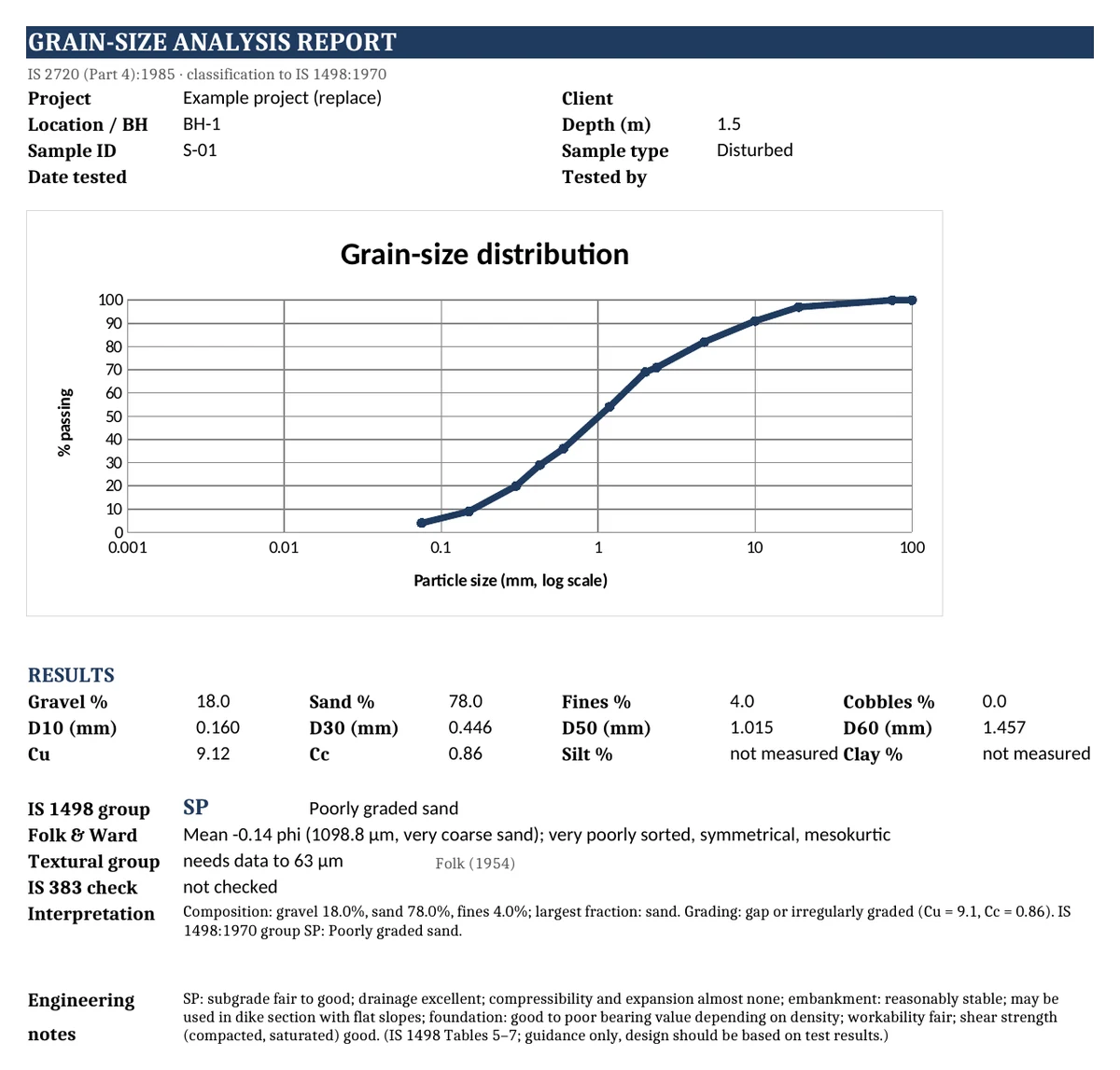
The printable report: curve, results, classification and interpretation
GrainLab grain-size analysis report with curve, results and classification
What it does

From sieve masses to a signed-off report

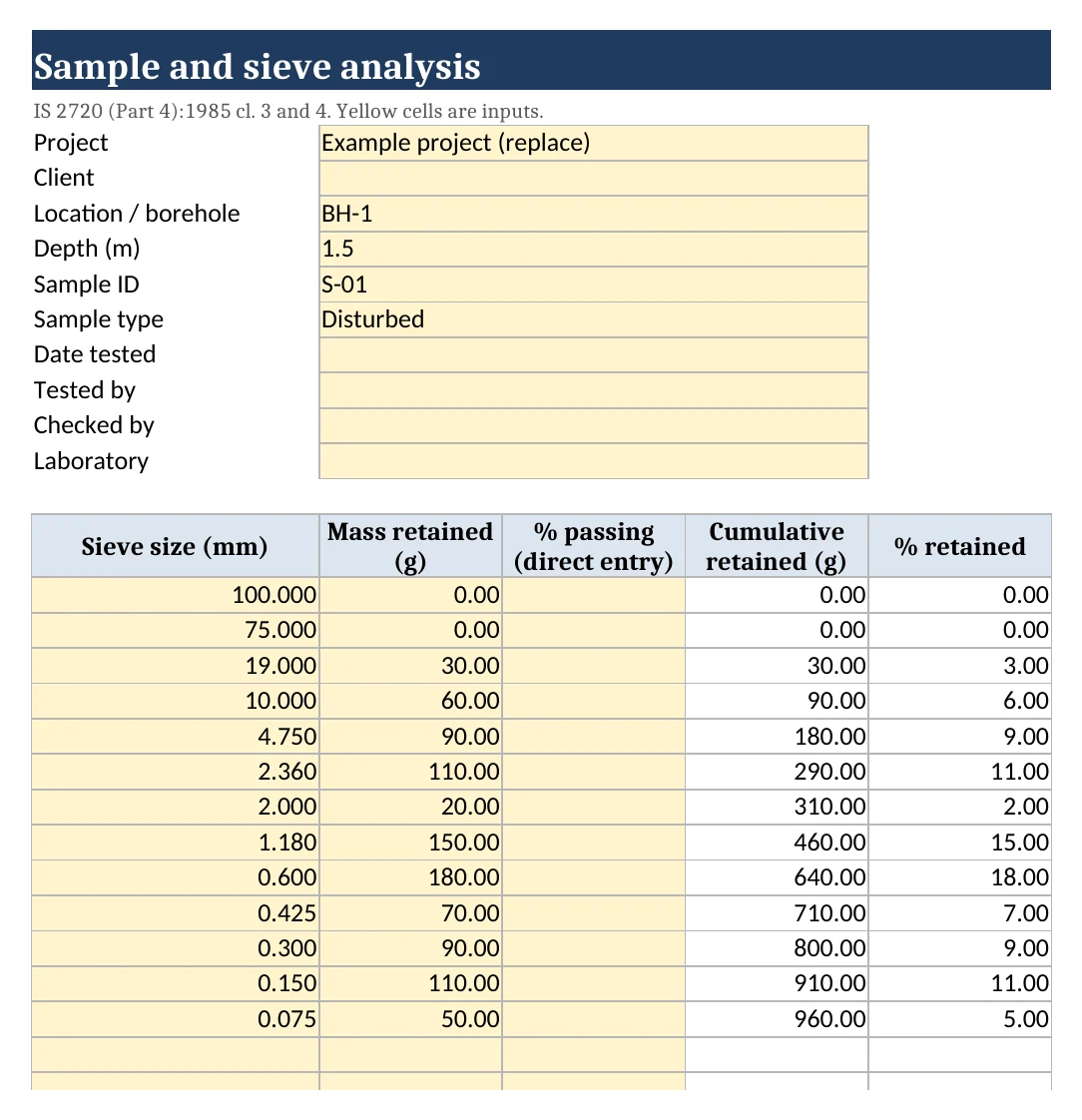
Enter the masses retained on each sieve (or % passing), add liquid and plastic limits if the soil has fines, and print the report.

Sieve analysis with clear inputs

Yellow cells are the only inputs. GrainLab works with retained masses or % passing, IS and ASTM sieves, and shows the ASTM E11 designation next to each size. Input errors and mass loss are flagged; nothing is extrapolated beyond your sieves.

  • IS 2720 (Part 4):1985 sieve analysis
  • D10, D30, D50, D60, Cu and Cc
  • Gravel, sand and fines fractions
GrainLab sieve input sheet

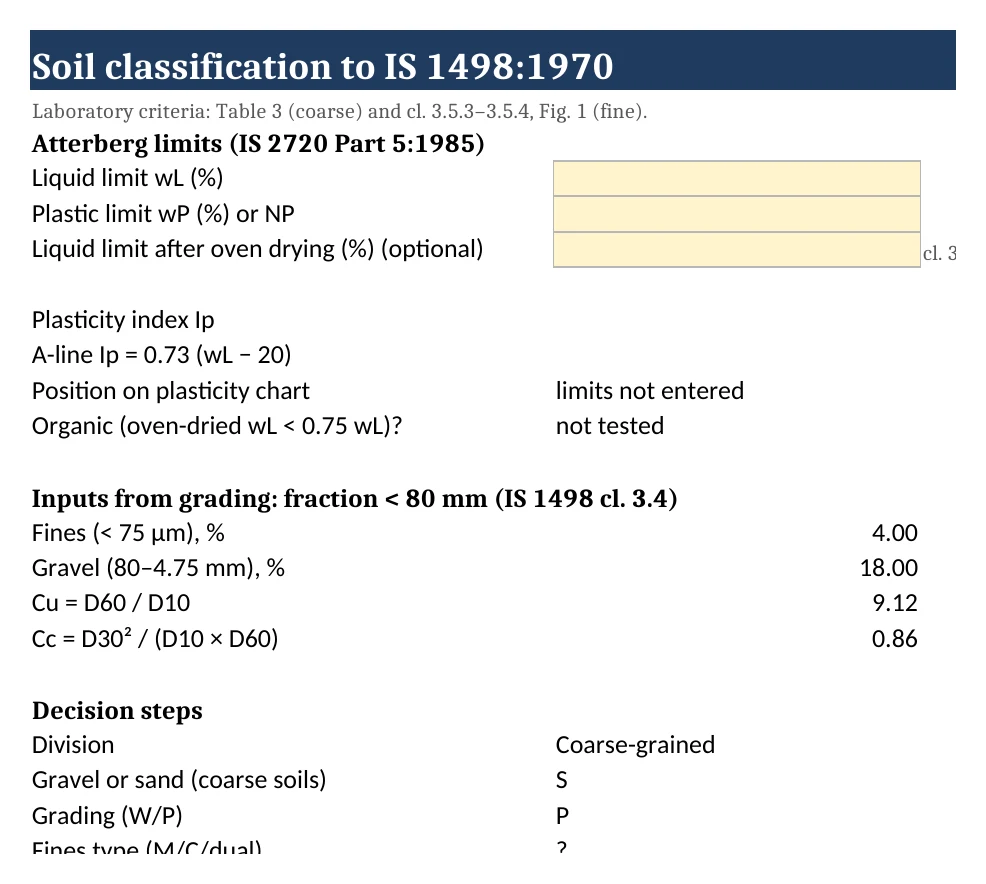
Soil classification with engineering notes

The IS 1498:1970 group symbol and name, with the plasticity chart and dual symbols, plus engineering notes on value as subgrade, drainage, compressibility, embankment and foundation use. Guidance only, with the exact clauses shown.

GrainLab soil classification sheet

A one-page report, written for you

The report gathers the curve, results, classification and a written interpretation of composition, grading and plasticity, ready to print and sign.

GrainLab one-page report

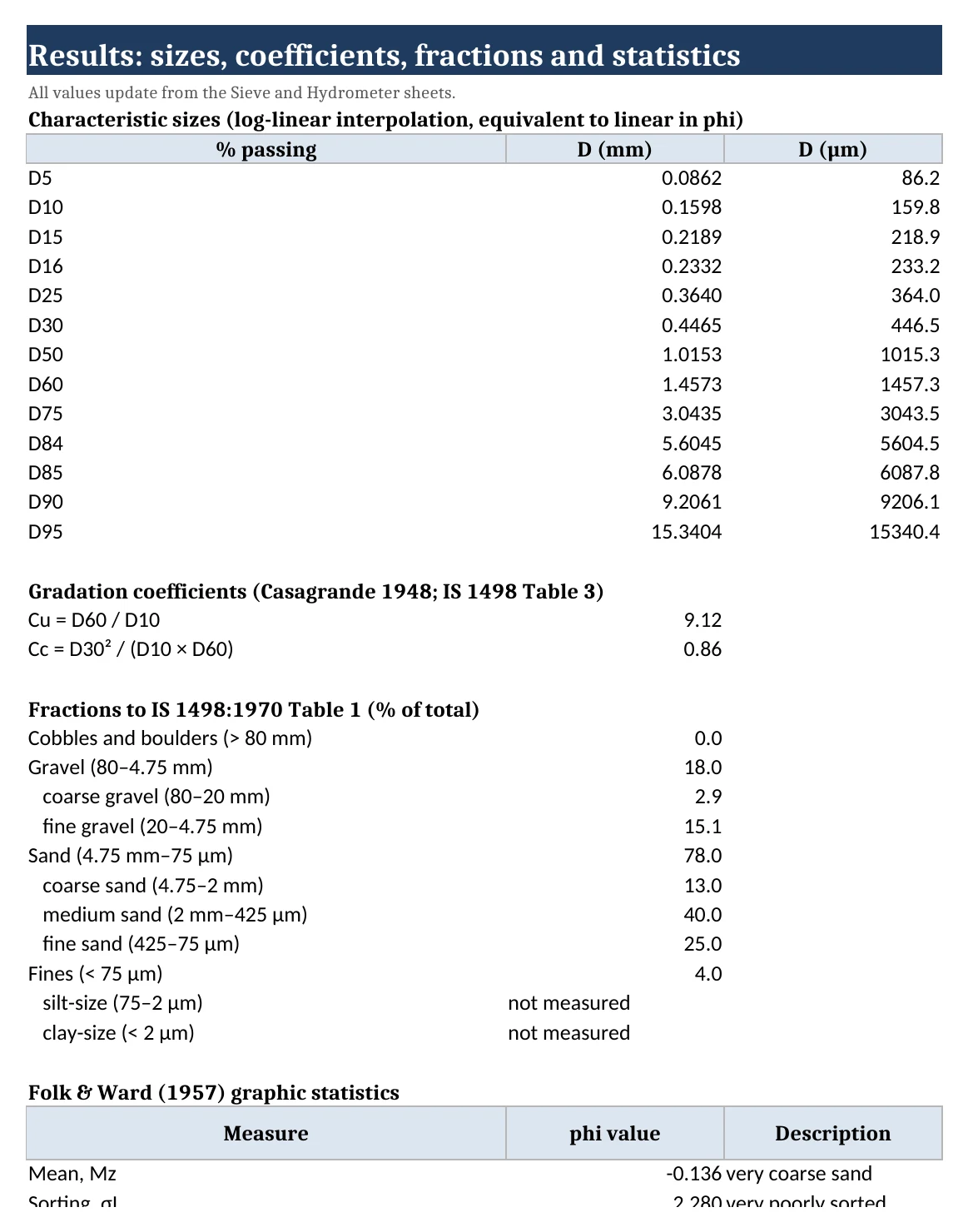
Statistics for sedimentology PRO

Folk and Ward (1957) graphic statistics, the method of moments and Folk (1954) textural groups: mean, sorting, skewness and kurtosis with their verbal classes.

GrainLab grain-size statistics sheet

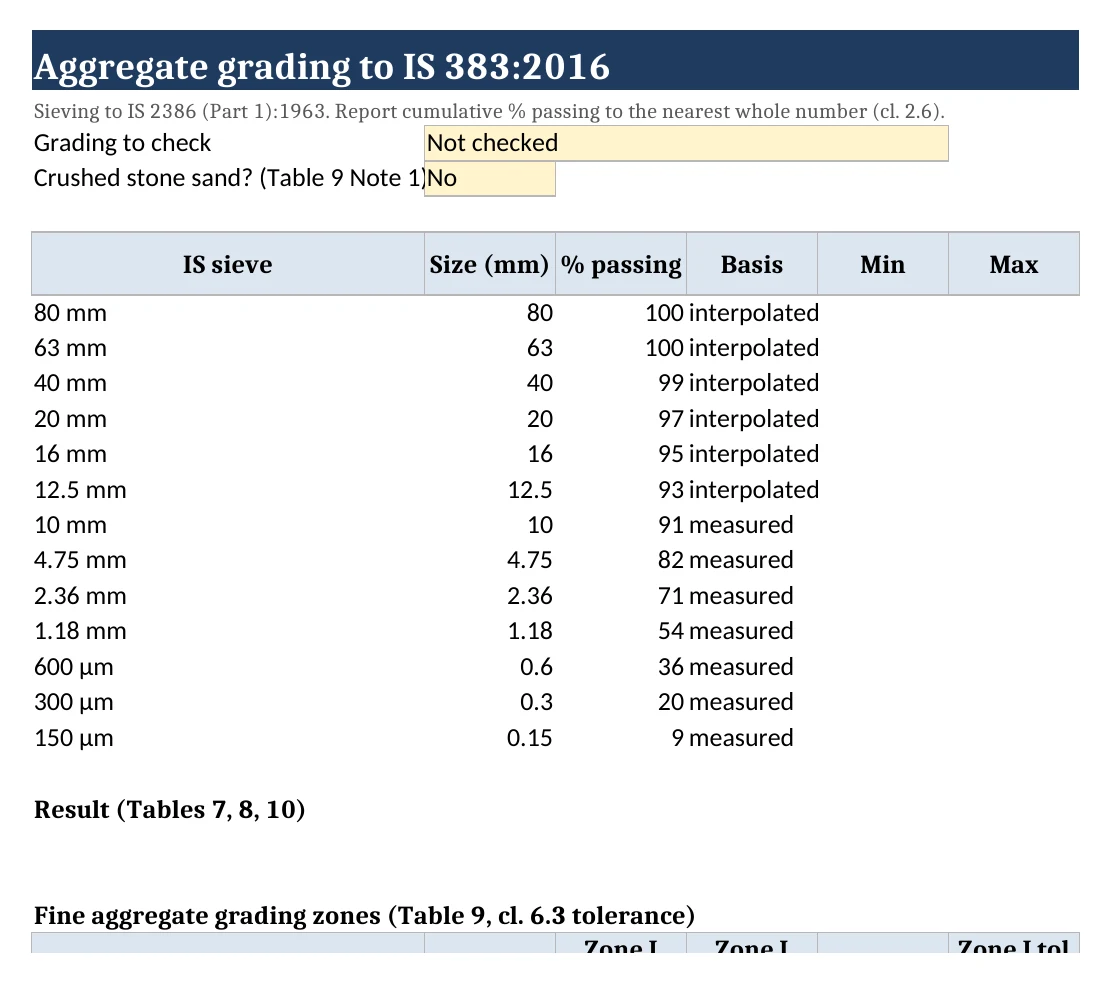
Aggregate grading PRO

IS 383:2016 sand zones (with the tolerance clause), coarse and all-in grading checks and the fineness modulus, sieved to IS 2386 (Part 1).

GrainLab aggregate grading sheet
GrainLab Pro

For labs, sedimentologists and materials engineers

Pro adds the analyses beyond the sieve.

Hydrometer analysis PRO

Fine fractions to IS 2720 (Part 4) cl. 5.2, combined with the sieve curve into one grain-size distribution, with silt and clay fractions.

Sediment statistics PRO

Folk and Ward (1957) graphic measures, moment statistics and Folk (1954) textural groups for sedimentological interpretation.

Aggregate grading PRO

IS 383:2016 sand zones, coarse and all-in grading and the fineness modulus.

Filter and permeability screening PRO

Filter compatibility ratios and a Hazen permeability estimate, clearly marked as screening indicators, not design values.

Compare editions

Free does the analysis. Pro goes further.

FeatureFreePro
Sieve analysis by retained mass or % passing; IS and ASTM sieves✓✓
Grain-size curve, D10–D60, Cu and Cc✓✓
Soil classification with plasticity chart and dual symbols✓✓
Written interpretation and engineering notes✓✓
One-page printable A4 report✓✓
Every formula visible and traced to its source✓✓
Hydrometer analysis combined with the sieve curve–✓
Folk and Ward statistics, moments and textural groups–✓
Aggregate grading, sand zones and fineness modulus–✓
Filter compatibility and Hazen permeability screening–✓
Pricing

Simple, one-time pricing

No subscription. Buy once and keep it.

GrainLab Free

$0

Free for research and teaching (CC BY-ND 4.0)

  • Sieve analysis and grain-size curve
  • D10–D60, Cu and Cc
  • Soil classification and interpretation
  • Printable A4 report
Download GrainLab Free (xlsx, 0.07 MB)

Excel 2016 or later, or LibreOffice Calc. No macros. Also archived on Zenodo.

Most complete

GrainLab Pro

$99 USD, one-time

Single-user licence, use on all your own computers

  • Everything in Free
  • Hydrometer analysis
  • Folk and Ward statistics
  • Aggregate grading and filter screening
  • Free updates for all 1.x versions

🔒 Secure checkout by Paddle · 30-day money-back guarantee

Prices in US dollars; local taxes are added at checkout where applicable. Lab, department and teaching licences: contact us.

Validation

How GrainLab was checked

Every number and every sentence GrainLab produces was compared with an independent implementation.

127 of 127

Fixed tests pass in GrainLab Pro, and 40 of 40 in GrainLab Free.

1,000+

Random datasets per edition (IS, ASTM and aggregate sieve sets, with and without limits and hydrometer) matched the independent implementation on every number.

2,000+

Workbooks compared word for word with an independent rule set for every text output: group names, interpretation, notes and warnings.

17 cases

Input errors give clear messages and no error cells.

2 programs

Microsoft Excel and LibreOffice Calc both reproduce the checks.

Every clause

Traceability: the Method sheet lists every formula with its standard and clause.

Questions

Frequently asked questions

What do I need to run GrainLab?

Microsoft Excel 2016 or later, or LibreOffice Calc. GrainLab has no macros and works offline.

Can I use ASTM sieves?

Yes. Enter the sieve opening in mm, for example No. 4 = 4.75, No. 10 = 2, No. 40 = 0.425 and No. 200 = 0.075. The sheet shows the ASTM E11 designation next to each size.

Which standards does it follow?

Sieve and hydrometer analysis to IS 2720 (Part 4), classification to IS 1498, and aggregate grading to IS 383 and IS 2386, with graphic statistics after Folk and Ward (1957). Each formula names its clause on the Method sheet.

How is D10 calculated?

D10 is read from the grain-size curve by interpolating the logarithm of size linearly between the two sieves that bracket 10% passing. The sheet does not extrapolate beyond the measured sizes.

How do I receive GrainLab Pro?

After payment you receive a download link by email with the workbook. Paddle also emails your receipt.

Can I get a refund?

Yes. Ask within 30 days of purchase for a full refund. See the Refund Policy.

How should I cite GrainLab?

Cite the version you used, and the methods and standards listed by the software.

Khan, A. (2026). GrainLab: a grain-size distribution, statistics and soil classification package for the analysis of soils and unconsolidated sediments, version 1.0.2 [Computer software]. Zenodo. https://doi.org/10.5281/zenodo.24372027
Analyse your next sample in minutes

Start with GrainLab Free. Upgrade for hydrometer analysis, statistics and aggregate grading.