DepthChron turns dated levels into an age for every depth. It calibrates your dates, builds a Bayesian or classical model, dates event layers and writes the methods paragraph. No coding, and it runs offline in your browser.

Seven clear steps, visited in any order: Project, Dates, Corrections, Calibrate, Model, Events and Export. A built-in demo shows every feature in under a minute.
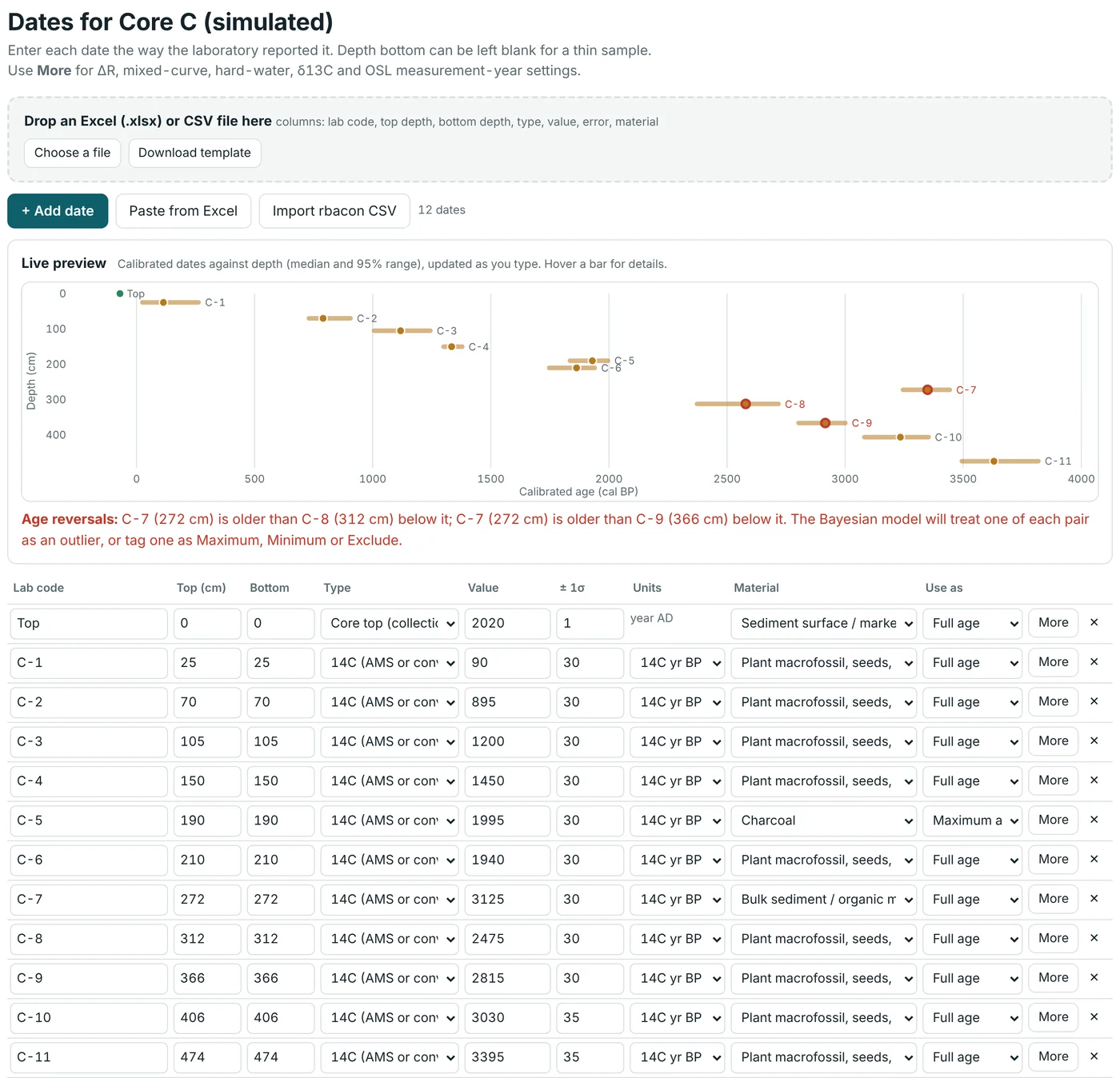
Enter radiocarbon ages as 14C yr BP, F14C or pMC, including post-1950 bomb samples, alongside OSL and IRSL ages, historical markers, the core-top year and the 1963 137Cs peak. Drop in an Excel or CSV file and a live preview plots each calibrated date against depth and flags age reversals as you type.

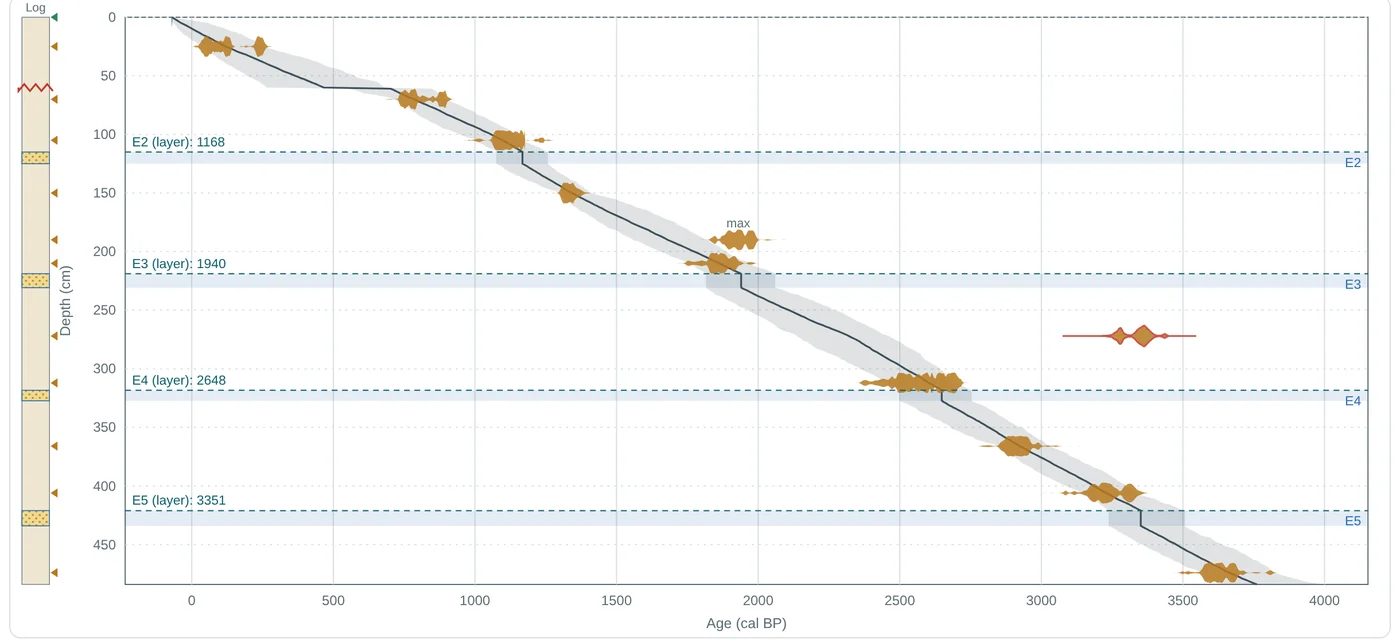
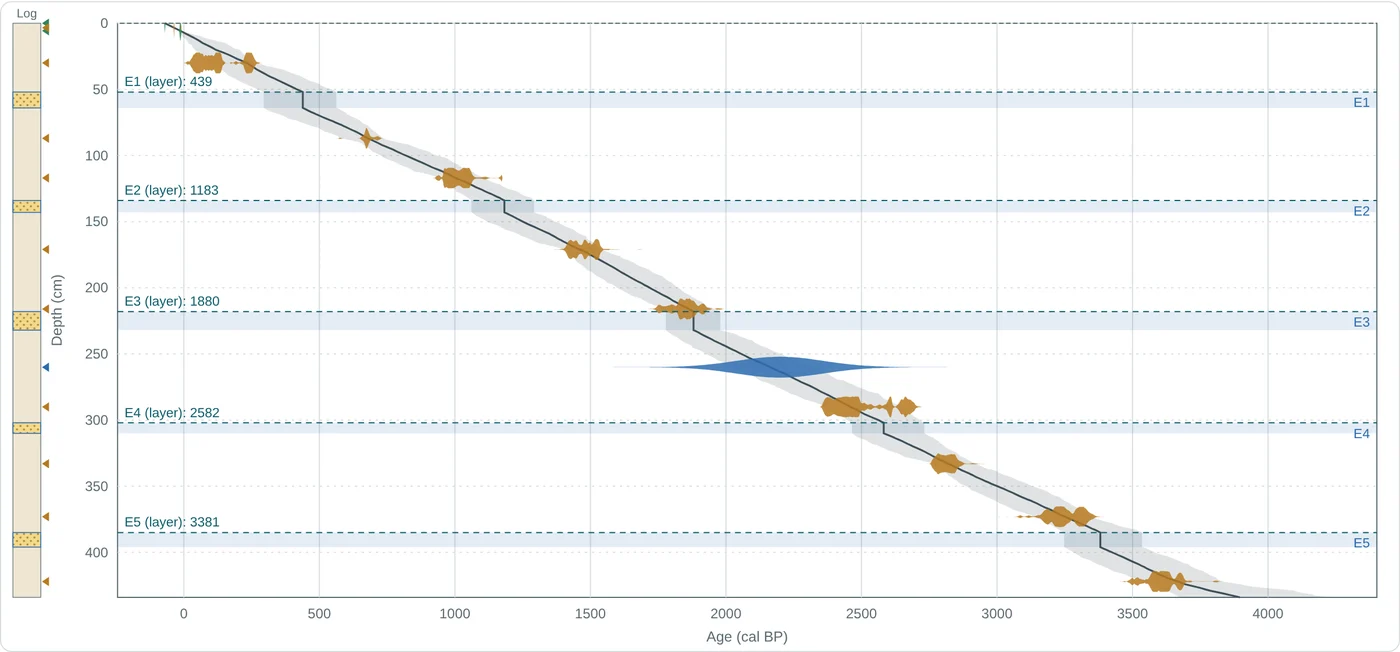
The Bacon-style model cuts the core into sections, lets accumulation rates vary with memory between neighbours, and down-weights dates that disagree. Several chains run and are compared, so you know whether the model has settled. Choose a Steady or Dynamic depositional environment with built-in guidance.

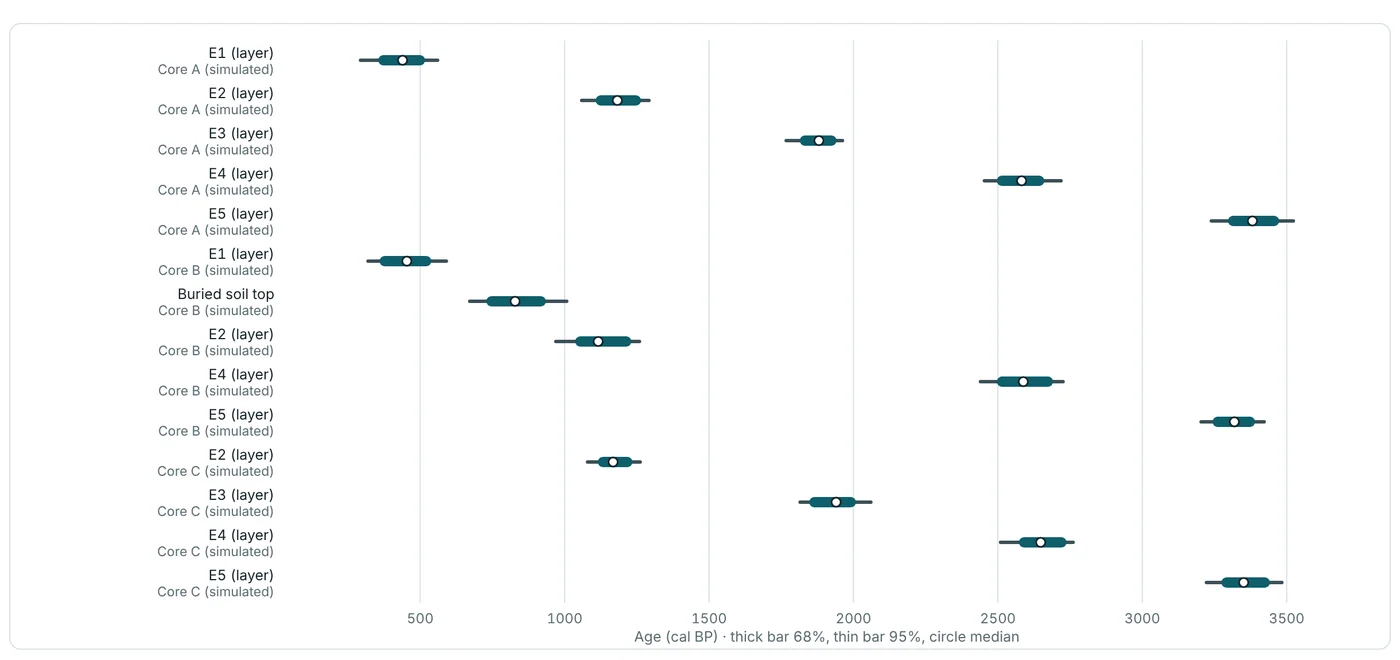
Mark single-event deposits and horizons, and DepthChron reports each one's age with 68% and 95% ranges, plotted on one time axis for every core. Compare events between sites at a glance, and export the table for your paper.

Pro reads the model for you, checks your settings first, and analyses how often events recur.
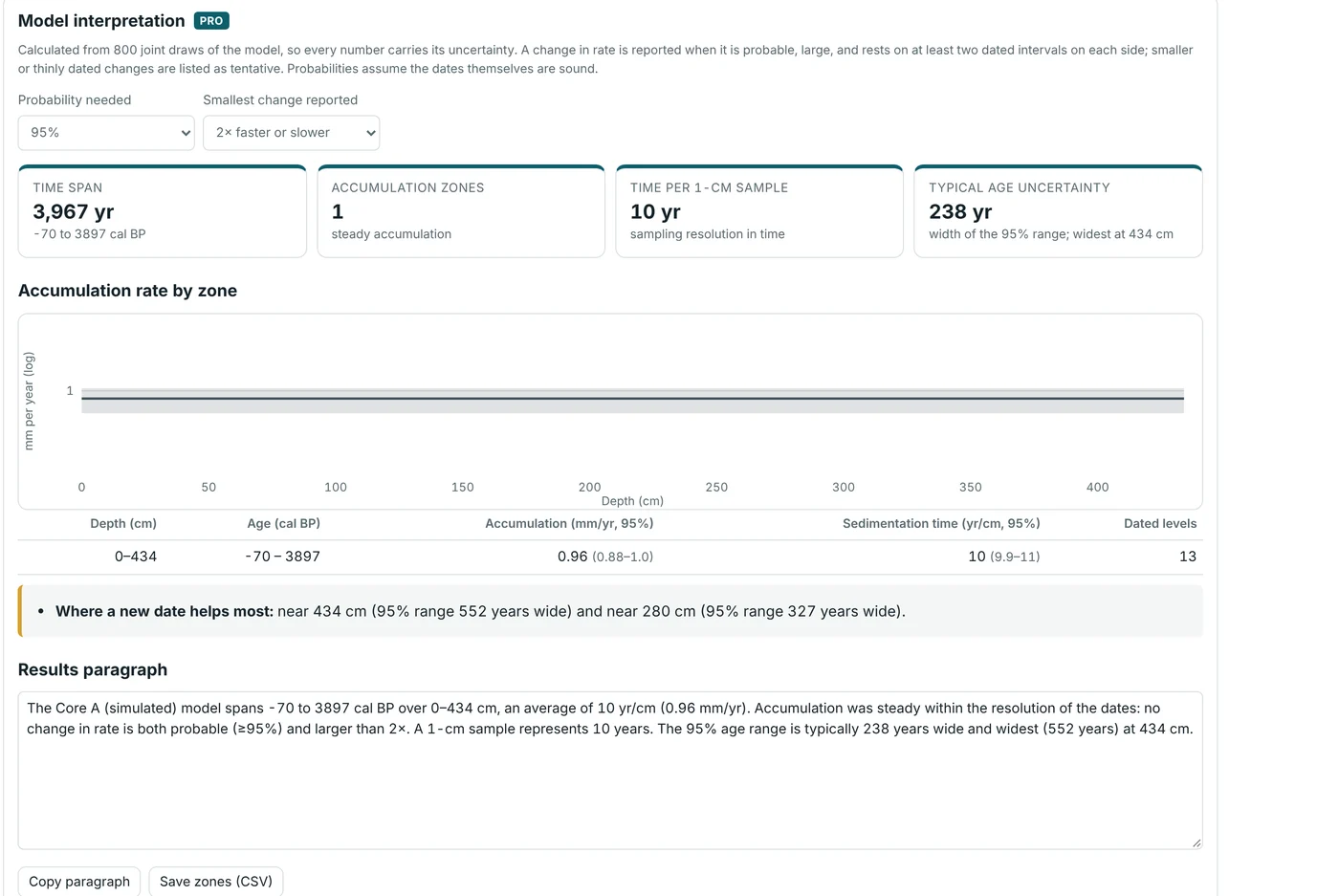
Accumulation zones with rates in mm/yr and yr/cm, each with its 95% range. Changes in rate are reported only when they are probable, large and backed by enough dates; smaller ones are listed as tentative. You also get the time missing at each hiatus, the years each sample represents, where one more date would help most, and a ready results paragraph.

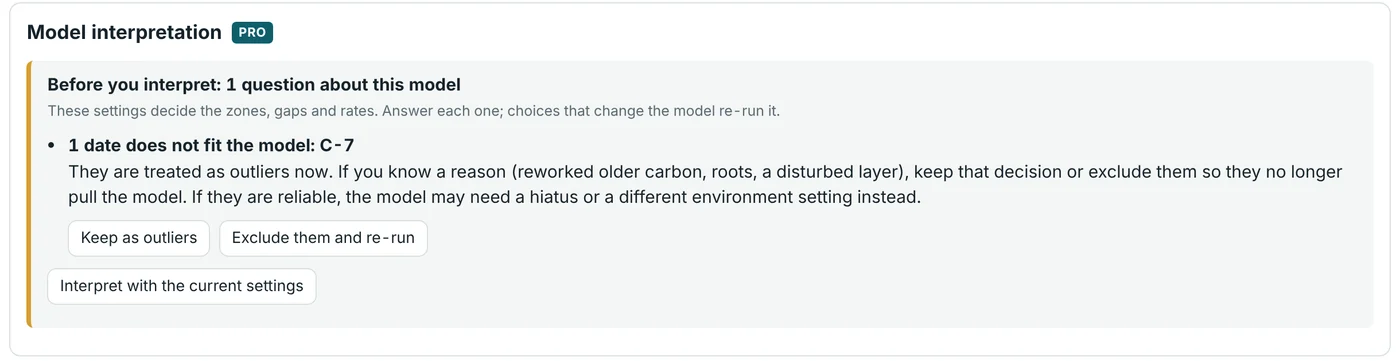
Before it interprets, Pro checks for an unsettled model, rejected dates, a date on a hiatus, a possible missed hiatus or event layer, too few dated levels, horizons outside the model and more, and asks you to decide. The interpretation stays realistic because the doubtful settings are dealt with first.

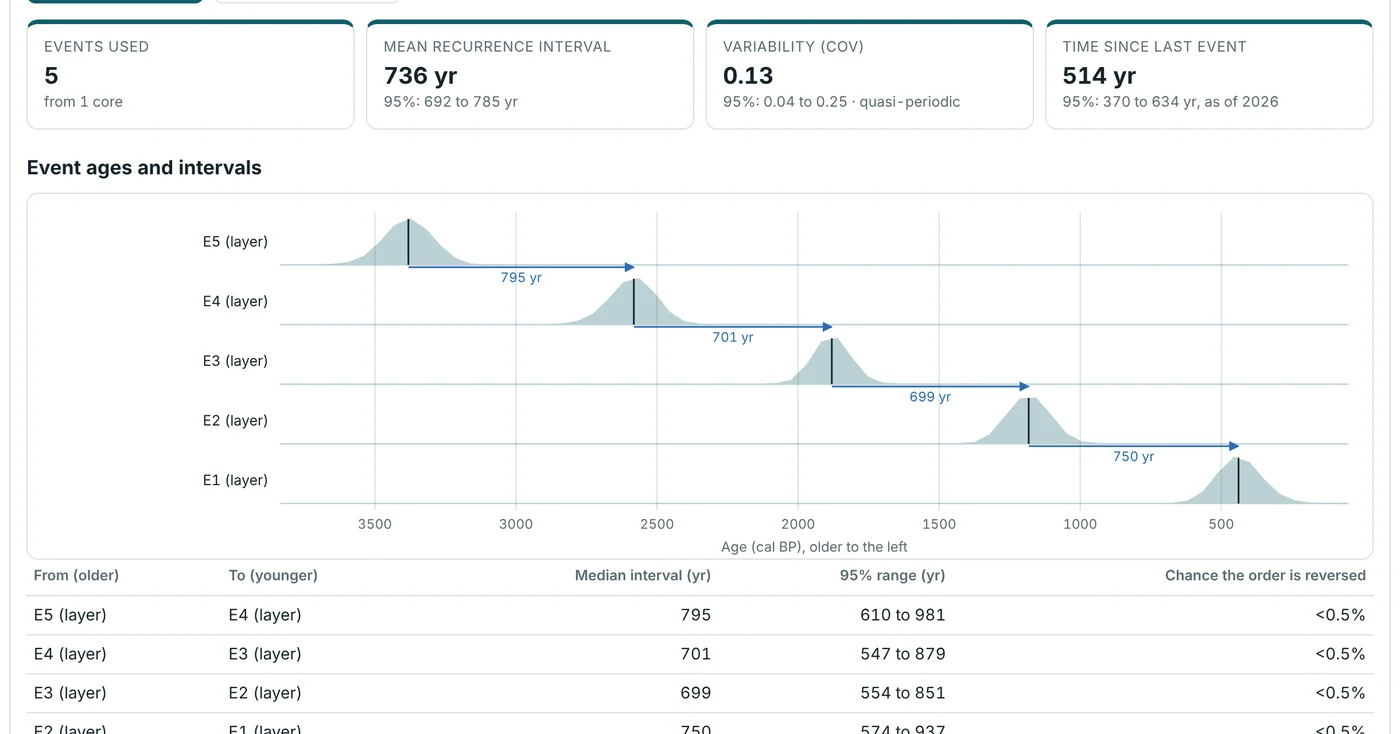
Intervals between events, the mean recurrence interval, its variability (CoV) and the time since the last event, all carrying the full uncertainty of the age models. Duplicate events between cores are kept out, and short records are flagged.

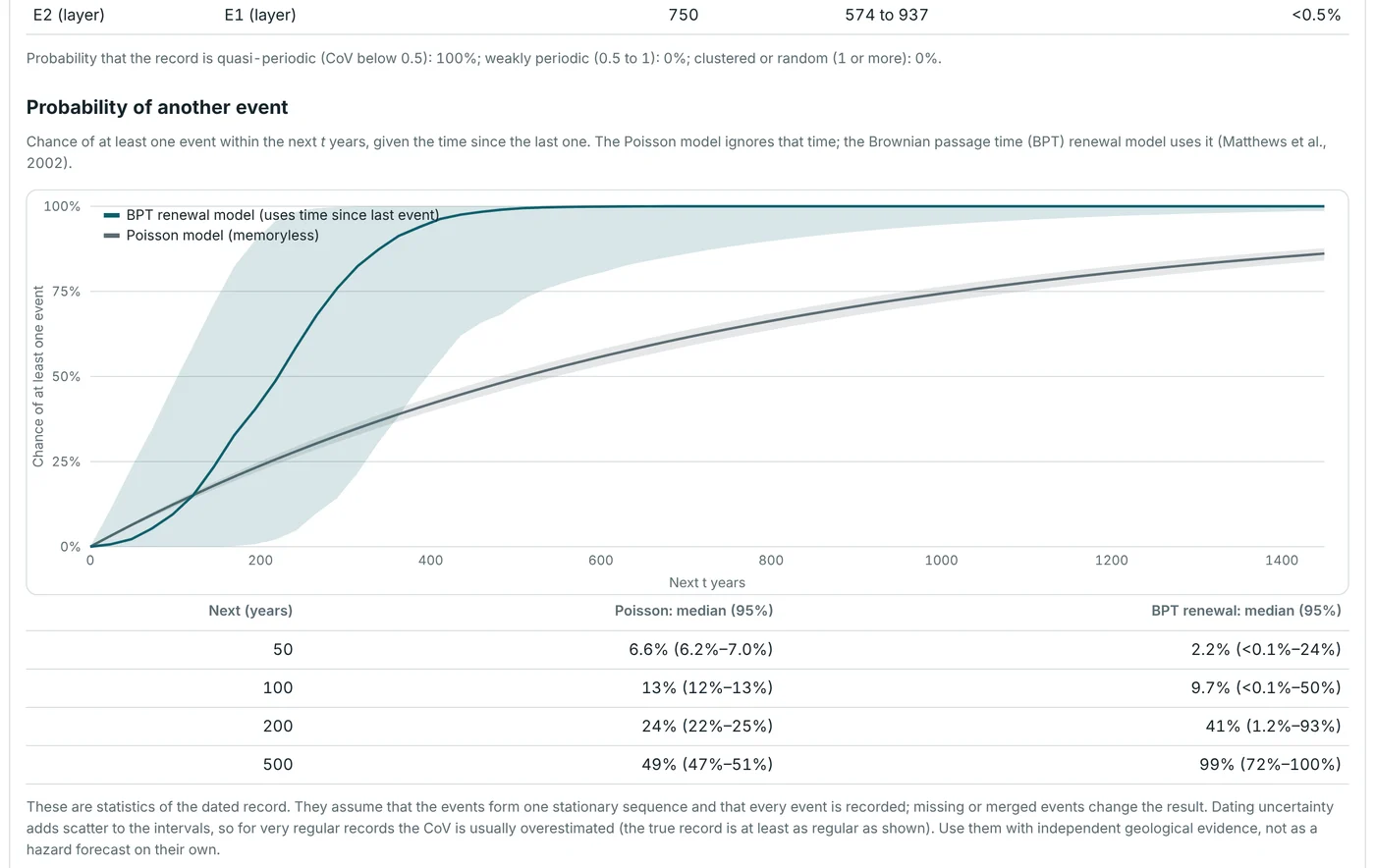
The probability of at least one more event in the next 50, 100, 200 or 500 years (or windows you choose), from a memoryless Poisson model and a Brownian passage time renewal model that uses the time since the last event.

DepthChron Free includes everything that Bacon, OxCal, CALIB and clam offer for free, with no limits on cores or exports.
| Feature | Free | Pro |
|---|---|---|
| Radiocarbon (including post-bomb), OSL / IRSL and calendar ages in one table | ✓ | ✓ |
| Corrections: marine reservoir (ΔR), mixed carbon, hard water, δ13C | ✓ | ✓ |
| Calibration with IntCal20, SHCal20, Marine20, Bomb21 and older curves | ✓ | ✓ |
| Bayesian (Bacon-style) and classical age-depth models | ✓ | ✓ |
| Outliers, hiatuses, event layers and event horizons | ✓ | ✓ |
| Unlimited cores; event ages compared across cores | ✓ | ✓ |
| Interactive figures; CSV, PNG and SVG export; methods paragraph | ✓ | ✓ |
| Model interpretation: accumulation zones, rate changes, hiatus gaps, results paragraph | – | ✓ |
| Checks of doubtful settings before every interpretation | – | ✓ |
| Event recurrence: mean interval, variability and time since the last event | – | ✓ |
| Chance of another event in the next 50 to 500 years (Poisson and BPT) | – | ✓ |
| Validation reports and data | – | ✓ |
No subscription. Buy once and keep it.
Free for research and teaching (CC BY-ND 4.0)
Also archived on Zenodo.
Single-user licence, use on all your own computers
🔒 Secure checkout by Paddle · 30-day money-back guarantee
Online checkout is opening shortly. To buy now, email [email protected].
Prices in US dollars; local taxes are added at checkout where applicable. Lab, department and teaching licences: contact us.
Each part of DepthChron was compared with the reference tools and with published records. The reports and data come with Pro.
Calibration matches CALIB 8.2 with IntCal20, SHCal20, Marine20 and mixed curves (calibrated medians).
Bayesian model medians on the MSB2K core in the rbacon package (Blaauw and Christen 2011).
Published chronologies from LegacyAge 1.0 (Li et al. 2022) fall inside Bacon's 95% range with the same settings; median difference about 16 yr per core.
Simulated cores with known true ages: the true age lies inside the 95% range at every depth on clean cores.
Pro interpretation on simulated cores with known answers: every true change in rate found, and no false changes after the checks.
Pro recurrence on simulated event records: the mean recurrence interval recovered in every case.
Published Lake Ulu core (Jia et al. 2024, Quaternary Science Reviews): published rates, base age and 215 of 219 Bacon ages reproduced.
A recent desktop browser: Chrome, Edge or Firefox. There is nothing to install and no internet connection is needed. Save the file anywhere and double-click it. A screen at least 1200 px wide is easiest.
No. All calculations run in your browser on your own computer. Your work is kept in the browser between sessions, and Save project writes a file you can reopen on any computer.
A Bayesian run usually takes from a few seconds to about a minute; long cores take longer. Runs keep going if you switch to another tab, and the same seed and settings always give the same result.
DepthChron uses the same kind of Bayesian age-depth model as Bacon and reproduces its results, but without R or coding. It also handles mixed dating methods in one table, dates event layers across cores, and writes the methods paragraph. Pro adds interpretation and recurrence analysis.
After payment you receive a download link by email with the software, the user guide, the README and the validation folder. Paddle also emails your receipt.
Yes. If Pro is not right for you, ask within 30 days of purchase for a full refund. See the Refund Policy.
Cite the version you used, and the calibration curves and methods listed in the methods paragraph.
Start with the free edition and the built-in demo. Upgrade when you are ready to interpret.